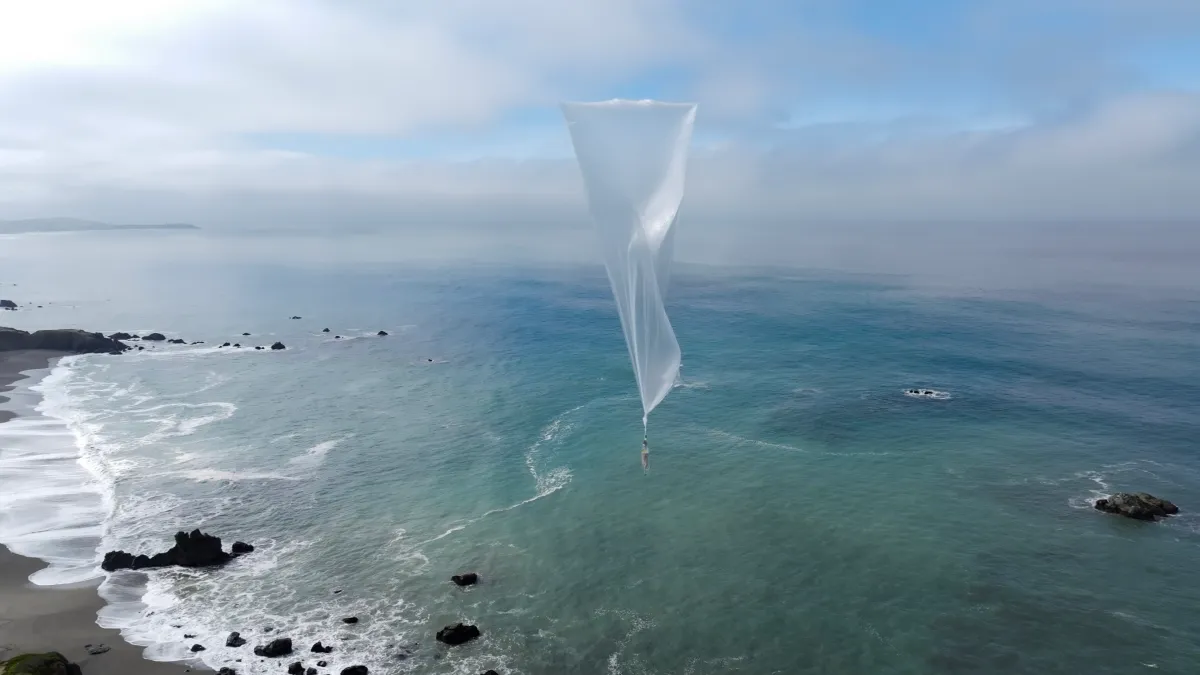
WindBorne Systems, a California-based weather balloon operator, has won a noncompetitive contract from the U.S. Air Force valued at up to $49 million, marking the startup's largest government agreement to date.
The Air Force will purchase atmospheric data collected by WindBorne's fleet of approximately 700 autonomous weather balloons operating globally. The contract structure allows the Air Force to place orders for specific regions and times as needed, paying only for data it requests. So far, the service branch has ordered $1.7 million worth of data, with executives expecting additional orders.
WindBorne, founded in 2015 and headquartered in Redwood City, California, feeds its sensor readings into proprietary AI weather forecasting models. The company's latest model, WeatherMesh 6, claims to outperform forecasts from the European Centre for Medium-Range Weather Forecasts, which relies on physics-based simulations.
Co-founder and CTO Andrey Sushko told TechCrunch the noncompetitive award reflects a government determination that "for this capability of collecting global data, we were the only company able to provide it in the way that met their needs for these operations." He added that contract funds will support constellation growth and research to improve balloon hardware and performance.
The startup has collaborated with the National Weather Service, U.S. Air Force and U.S. Navy previously, but this represents a substantial scaling of that relationship. In August, WindBorne closed a $37 million Series B funding round to accelerate business expansion.
The contract reflects broader momentum in AI-driven weather forecasting. Deep-learning weather models, enabled by transformer architectures and large datasets released by government agencies, now compete with traditional supercomputer-based forecasting. Google DeepMind and other frontier laboratories have deployed AI models that in some cases exceed traditional forecast accuracy, though meteorologists continue using both approaches.
In August, WindBorne achieved an operational milestone by deploying an unpowered balloon system into a typhoon's eye to collect data. The company navigates balloons by adjusting altitude, venting air, or dropping ballast sand to position them in wind currents. Sushko noted this represented the first operational use of a deep-learning model for such navigational decisions, requiring both accurate wind modeling and a sufficiently large balloon constellation.