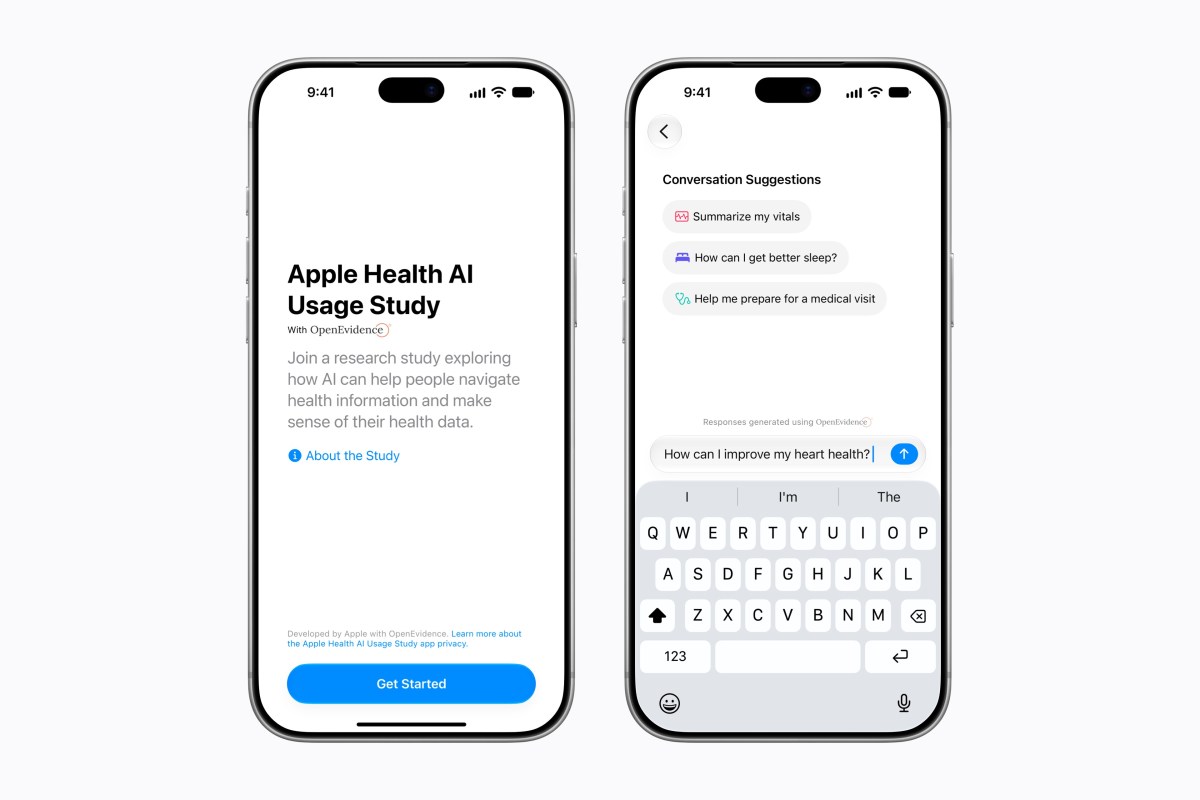
Apple is asking up to 200,000 American iPhone users to test a health chatbot and share their answers, feedback and, if they choose, data from HealthKit such as resting heart rate, sleep, activity and lab results. The company is partnering with OpenEvidence, a healthcare-focused AI company, to run the study for more than 12 months. Apple says the app will ground its answers in clinical sources including The New England Journal of Medicine, the Journal of the American Medical Association and Nature.
The pitch is reasonable on its face. Sumbul Desai, Apple's vice president of Health and Fitness, said in a statement that "responsible innovation starts with scientific rigor and clinical grounding." Clinically sourced answers are better than the confident guesswork that general chatbots sometimes produce, and asking how people actually read and act on health AI is a fair question. Apple also says the data will be anonymized, will not be used to train AI models, and will be deleted by OpenEvidence after 24 hours. Those commitments matter, and they are the ones readers should hold Apple to.
Still, the study asks a lot of trust. Participants would be sharing sensitive health information and agreeing to monthly surveys, and the report does not explain exactly how anonymization works, what the secure third-party cloud provider is, or what happens to data that is retained for the study rather than the 24-hour query logs. A 24-hour deletion window for query and response data says nothing about the survey answers, ratings or HealthKit records that the study is actually designed to collect. Participants deserve a clear, plain-language account of each category of data, who can access it, and how long it lasts before they opt in.
The report also points to a gap that regulators should not ignore. Apple says the app will guide users to specific providers for concerning symptoms and help them prepare for doctor visits, yet it is unclear whether those functions will ever reach the built-in Health app or Siri. The report notes that OpenAI said users were asking over 300 million health-related queries each week, a figure that shows how quickly this behavior has become routine. When millions of people rely on these tools, a research study with 200,000 volunteers is a useful start, not a substitute for public standards on accuracy, data use and accountability.
Apple should publish its study protocol, the data retention schedule for every category of information, and the identity of every data processor before enrollment grows. It should also commit to reporting findings publicly, including where the app fails. If Apple wants to be the trusted health brand it describes, the study must earn that trust through transparency rather than assume it.