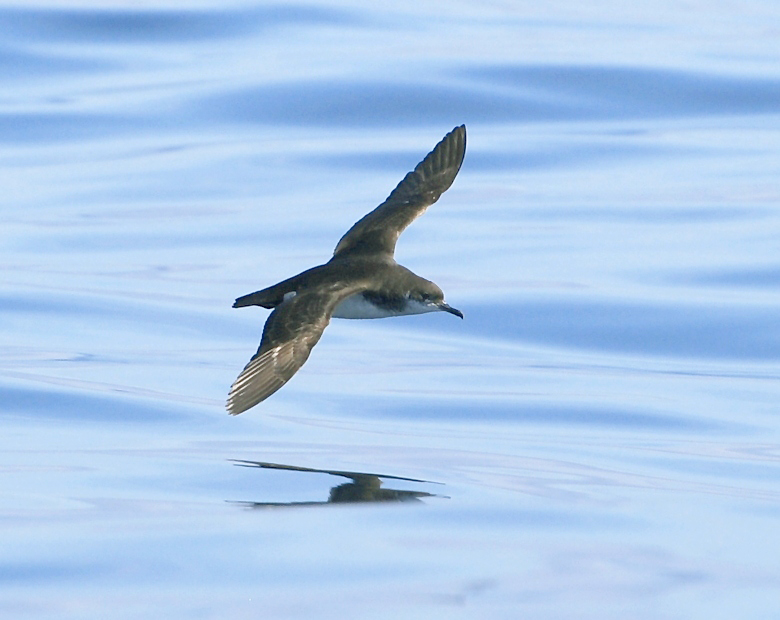
Manx shearwaters that fly long distances over the Atlantic can suffer a form of jet lag that skews their navigation, according to a new study published in Science. Patrick Lewin, a behavioral and sensory ecologist at the University of Oxford and the study's lead author, said the birds' internal clocks fall out of sync as they cross lines of longitude.
The birds use the Sun as a compass to find their way home. Their internal clock is used to judge where the Sun should be, but it recalibrates only at dusk and dawn. As a result, the study reports, a bird's clock falls about four minutes out of sync with local time for every degree of longitude it crosses between sunrise and sunset. The birds then veer clockwise when flying east and anticlockwise when flying west.
The researchers analyzed GPS tracks from 3,688 foraging trips by 1,045 birds from colonies along the UK's western coasts. They isolated 335 homing flights made out of sight of land. The birds' deviations matched the predictions of the Sun compass model. The team said crosswinds, the Coriolis effect and a magnetic compass did not fit the data as well. Lewin cautioned that the study was not a controlled experiment, so causality should be interpreted carefully.
According to Lewin, the navigational errors reached up to about 15 degrees. For a shearwater flying 1,000 kilometers east in a day, the team calculated an average error of roughly seven degrees. The researchers estimated that if the bird continuously checks its position, the error adds only about five kilometers to the trip.