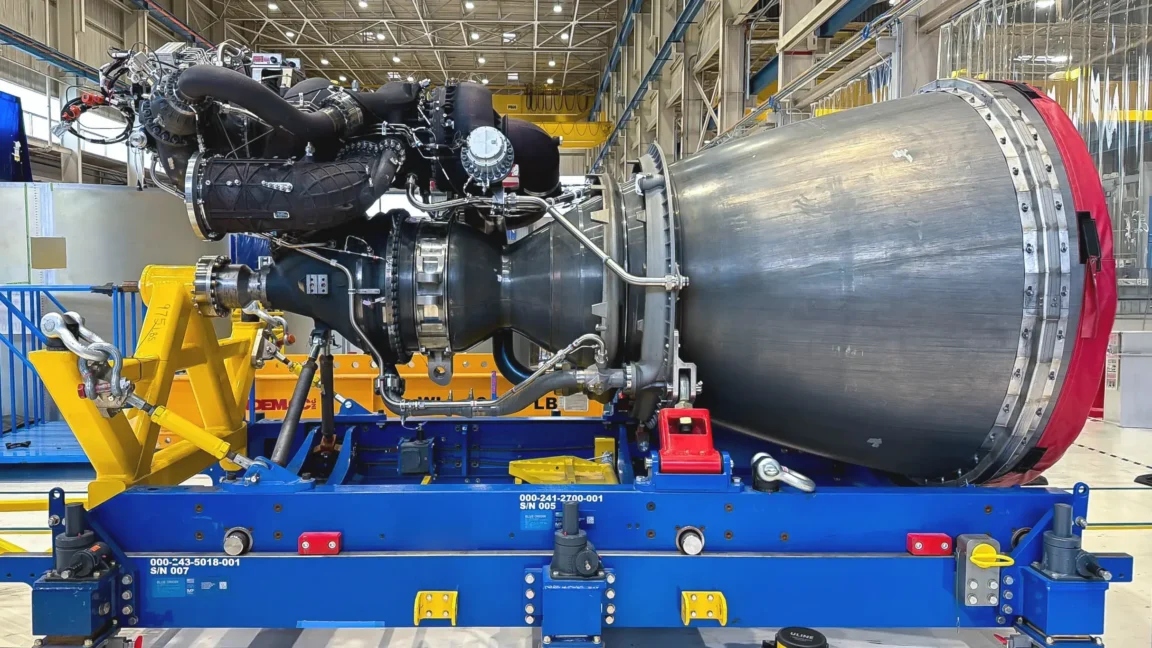
Blue Origin said on Thursday that it is developing upgrades to its New Glenn rocket that would lower manufacturing costs and increase payload capacity to geostationary orbit and the Moon. The company announced the plans at the UP.Summit conference at the Shuttle Landing Facility in Florida, according to the source report.
Dave Limp, Blue Origin's chief executive officer, said, "There has never been higher demand for launch, ever." The company aims to eventually position New Glenn to launch more than 1,000 times a year.
Blue Origin has begun test firing a new engine called Northstar, which would eventually replace the BE-4 engine that powers New Glenn's first stage. Limp said Northstar is a simplified version of the BE-4 with half the number of parts, 30 percent less mass, and about 65 percent of its components that can be 3D-printed. Limp said the engine would have a starting thrust of 715,000 pounds, compared with 640,000 pounds for the BE-4. The company believes it can build Northstar at 25 percent of the cost of a BE-4.
The company is also developing a hydrogen-oxygen third stage called GS3. According to Blue Origin, a GS3-equipped New Glenn 7×2 could carry 8 metric tons directly to geostationary orbit and 10 metric tons to translunar injection. Those figures would rise to 14 and 20 tons for the larger 9×4 variant. The report states that the stage is made mostly of composites, and that the company completed its first composite liquid hydrogen tanking test at Launch Site One in Texas. Limp said the company aims to debut GS3 in 2028 for a government customer.
Limp said Blue Origin will continue to manufacture the BE-4 for United Launch Alliance, which uses two of the engines to power its Vulcan rocket.