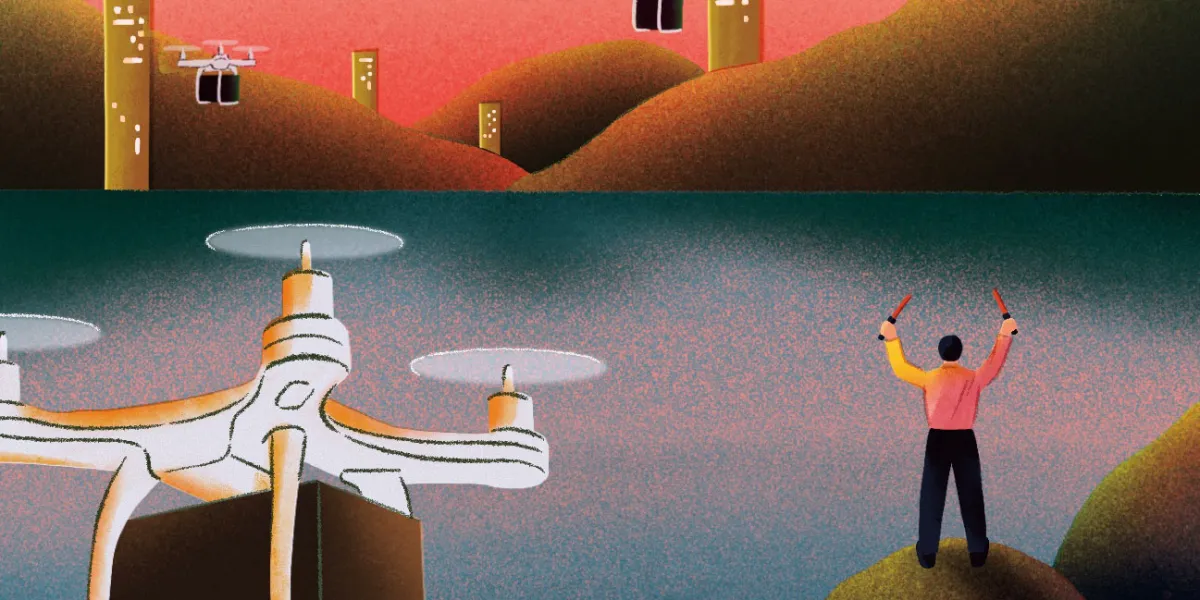
Trevor Wischnewsky holds a job title that barely existed two years ago. As a remote pilot in command (RPIC) at FlyTrex, he manages fleets of delivery drones operating over Dallas, monitoring up to 10 aircraft simultaneously from the company's operations center.
The role resembles air traffic control but for autonomous hexacopter drones rather than manned aircraft. Wischnewsky does not pilot the drones himself. Instead, he monitors their delivery process using inputs from GPS, lasers, and onboard sensors. His primary responsibility is ensuring safe passage for parcels while coordinating traffic with competing delivery drone operators including Amazon, Zipline, and Alphabet's Wing, according to MIT Technology Review.
FlyTrex requires applicants to hold FAA commercial drone pilot certification plus completion of a weeks-long FAA-approved training course. Wischnewsky met these requirements while training to become a commercial pilot and flight instructor. The certification ensures pilots can assume manual control if necessary.
The Dallas-Fort Worth area functions as a testing ground for unmanned aircraft systems traffic management (UTM), a network allowing autonomous drones from multiple operators to share real-time coordinates and help prevent collisions beyond visual line of sight. Once Wischnewsky confirms a drone is flight-ready, its flight path is clear, and weather conditions are safe, UTM handles collision avoidance automatically.
Wischnewsky described his early challenge as learning to trust the automation. "On the manned-aircraft side, they tell you 'Don't trust the automation,'" he said. That mindset required adjustment for autonomous drone operations. He now serves as a safety net even when automation functions properly, maintaining situational awareness to intervene when needed.
Weather presents the most common hazard. Wischnewsky recalled an incident when wind suddenly intensified seconds after launch, forcing him to return a drone safely to the ground and prevent an ice cream cake from striking a sidewalk.
The position reflects emerging job categories tied to drone delivery expansion. As multiple operators deploy delivery aircraft across urban airspace, the need for trained personnel to manage autonomous vehicle traffic and maintain safety protocols continues to grow.