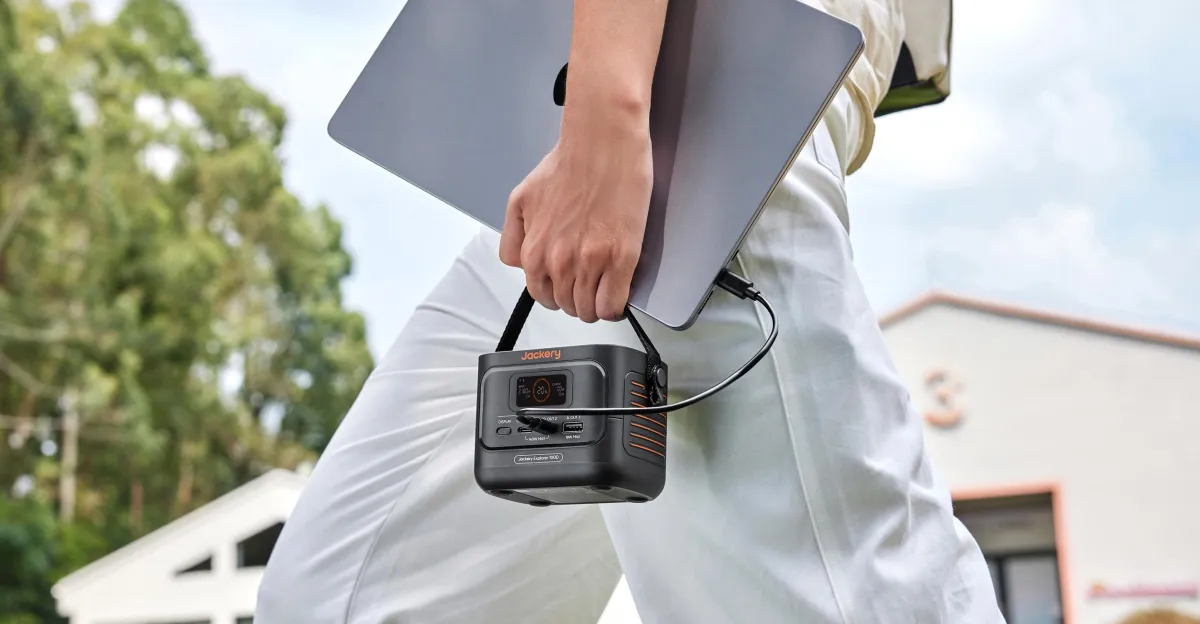
Jackery's new Explorer 100D is a neat piece of hardware. The company says it is its smallest portable power station to date, measuring 4.6 by 3.4 by 3.4 inches and weighing 1.87 pounds, with 96Wh (30,000mAh) of battery capacity. It uses lithium iron phosphate (LFP) cells, which Jackery says are safer and last longer than common lithium-ion cells, claiming they are "engineered for up to 8 years of regular use" with a 3,000 charge cycle lifespan. For someone trying to fit a charger into a carry-on, that is a sensible pitch.
The price is also easy to understand. The 100D will be sold through Walmart starting November 15th for $99, and Costco already carries it in a two-pack for $179.99. The report notes that cheaper and smaller 30,000mAh chargers exist, so the case for this product rests on its battery chemistry and durability rather than on being the lowest-cost option. Buyers should weigh that claim against the price difference.
The report also gives useful specifications that matter in daily use. There are two 140W USB-C ports and one 18W USB-A port, but total output tops out at 158W, so power drops when all three ports are in use. The unit accepts up to 100W of direct solar input and can reach about 80 percent charge in roughly an hour and a half. Those are the numbers a reader should check against their own devices and travel habits, not the marketing language around them.
What the report does not provide is just as important as what it does. Nothing in the source material addresses data handling, connectivity, firmware updates, or whether the device collects any information about its owner. Power stations are often treated as dumb hardware, but products sold through large retail channels increasingly come with apps, accounts, and telemetry. Before buyers rely on a device like this, the manufacturer should state clearly whether it connects to the internet or stores usage data, and retailers should make that information visible at the point of sale.
My view is simple: the 100D is a reasonable product that delivers on portability and battery longevity, and consumers should be able to buy it on those merits. But good hardware does not excuse vague disclosure. Jackery should publish a plain statement on data practices for this model, and Walmart and Costco should require it in product listings. Until that exists, a small battery that is easy to carry should not also be a silent unknown in terms of what it reports back.