Spanish archaeologists cataloged 597 wooden remains from a Neanderthal rock shelter near Barcelona, dating from 62,000 to 40,000 years ago. The discovery challenges assumptions about Neanderthal cognitive abilities and material culture.
The site, Abric Romaní, preserves wood through an unusual process. Mineral-rich water from a travertine cliff deposited a limestone crust around wooden objects. As the wood decayed inside this protective shell, it left behind hollow molds that captured fine details, sometimes showing individual wood cells under microscopy.
Researchers found 13 objects shaped or modified by Neanderthals among the 597 remains. These include four shallow trays made from juniper bark, the largest measuring 55 by 20 centimeters, positioned near hearths. M. Gema Chacón, an archaeologist at the Catalan Institute of Human Paleoecology and Social Evolution, notes these may have carried food or scooped embers, similar to coolamons used by Aboriginal Australians.
The shelter layout reveals deliberate spatial organization. Along the back wall, Neanderthals maintained a row of small hearths spaced roughly one meter apart with minimal debris, which Chacón interprets as sleeping areas. A branchless pole exceeding five meters long, found deeper in the shelter, likely leaned against the wall to form a windbreak or simple hut structure.
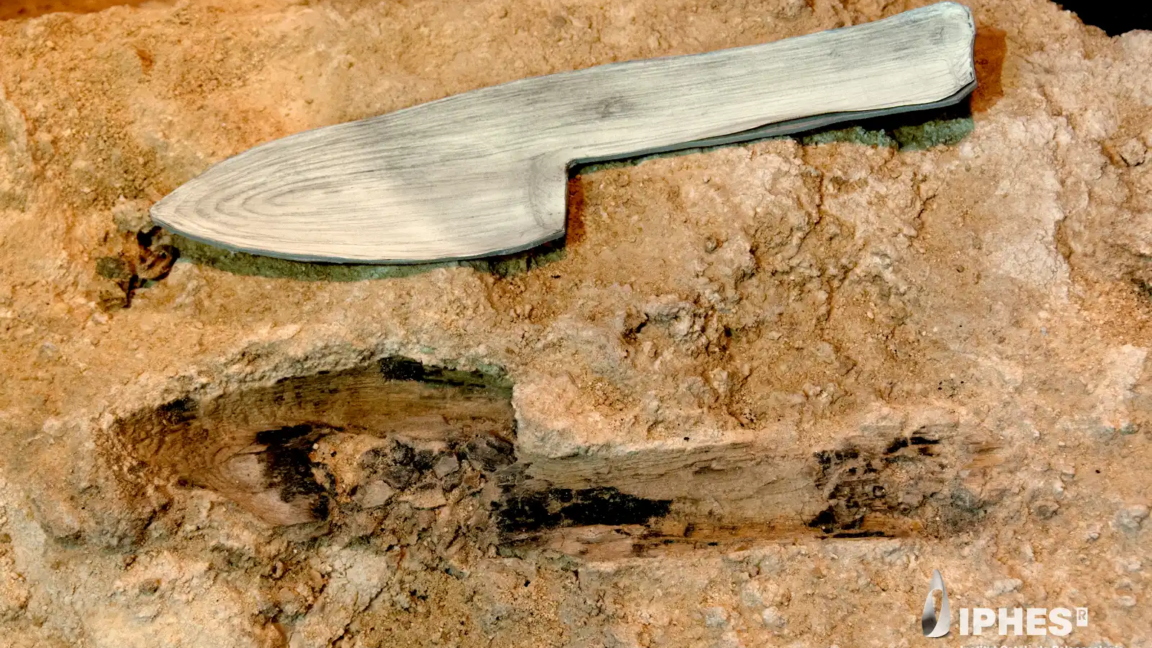
A carved wooden club represents the most unusual find. Fashioned from a single piece of wood with a 16-centimeter handle and pointed, roughly triangular head, it features an abrupt right-angle step where handle meets head, possibly to prevent hand slippage. Chacón states nothing comparable has been found elsewhere. No known club of similar design predates a roughly 400,000-year-old specimen from Kalambo Falls in Zambia.
Spears near red deer skulls showed impact fractures identical to those on Aboriginal Australian weapons, indicating strikes against bone. The best-preserved spear measures 2.45 meters.
Material selection demonstrates environmental knowledge. Neanderthals chose Scots pine for tools because it was easy to work and dried quickly, making tools cheap to replace. They selected juniper bark for its fibrous quality and collected dry wood for fuel while using fresh wood for crafted items.
The findings appear in Science Advances. Excavation at Abric Romaní has continued since 1983. Current methodology includes 3D scanning and photogrammetry to digitize the hollow molds, with 3D printing used for research and display rather than plaster or resin casting.