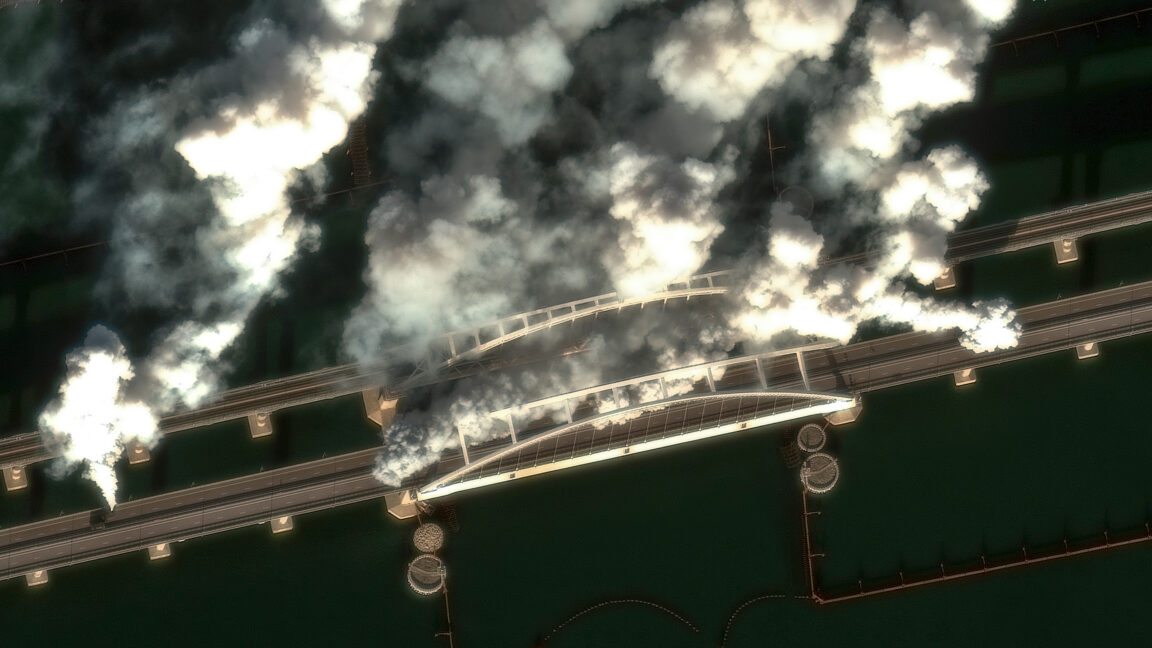
Ukraine's strike on the Kerch Strait Bridge is a striking demonstration of what homegrown technology and battlefield adaptation can achieve. According to the Institute for the Study of War, coordinated Ukrainian drones and missiles on November 15 and 16 caused enough damage to collapse one of two steel arches supporting the roadway. The operation was reportedly carried out without relying on Starshield, the military version of Elon Musk's Starlink network, which the Financial Times says Ukrainian units deliberately avoided.
The reason they avoided it matters. Recent US restrictions reportedly bar Ukraine from using Starshield on drones or anything else traveling faster than 100 miles per hour. Zelenskyy said those restrictions have not been lifted, while SpaceX denied they had returned. Whatever the precise status, the episode shows that a single private company's terms and a foreign government's policy can shape how a country defends itself. Ukraine's engineers have now shown they can work around that dependency, but they should not have been forced to.
The technical lesson is equally clear. Per the Financial Times, Ukraine used drones with mesh radios to form an airborne relay network, letting operators more than 250 kilometers away guide missiles and drones past air defenses. The technique was borrowed from Russia, which had used it against Ukrainian cities. That cycle of adoption and counter-adoption is how modern drone warfare evolves, and it is a reminder that communications resilience is now a strategic asset, not a convenience.
The consequences for Russia are serious. The Institute for the Study of War assesses that destruction of the bridge will complicate Russia's ability to maintain its occupation and basing in Crimea. Engineering experts told The New York Times that roadway repairs could take two years under normal circumstances, and that damage to the piers could extend that timeline. Putin's bridge, which cost $3.5 billion and was meant to cement Russia's claim, has now been struck repeatedly.
What should happen next is a clearer policy on dual-use satellite services. Allies supplying Ukraine should decide transparently whether restrictions on tools like Starshield serve a legitimate purpose, and companies providing critical communications should not leave defenders guessing about what is permitted. Ukraine has earned the right to use the tools it depends on, and the bridge strike proves its engineers can adapt. The question now is why policymakers keep making that adaptation necessary.